Spotlight Artist: Lucy George
Patrick Bell
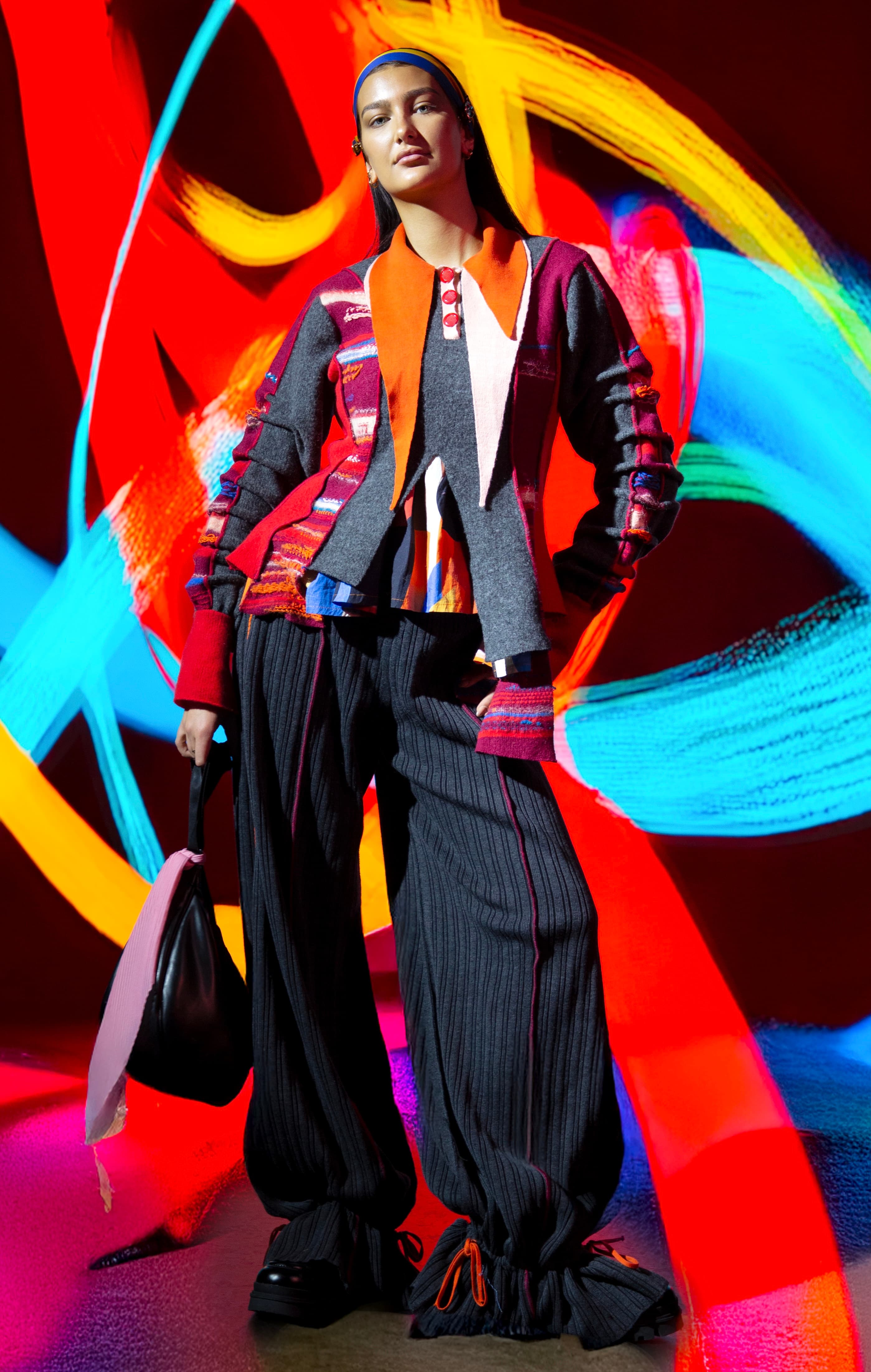
Lucy George is an artist from Diggle, Saddleworth. At nineteen, she staged her first exhibition at the Weavers Cottage Gallery in Uppermill...
Spotlight Artist: Lucy George
Lucy George is an artist from Diggle, Saddleworth. At nineteen, she staged her first exhibition at the Weavers Cottage Gallery in Uppermill. She has since moved to Nottingham, where she’s continued to develop her textile practise and curate a popular online presence. We caught up with her a few weeks ago to ask some questions about her process and its deep grounding in her rural upbringing.
Hello Lucy, thanks again for agreeing to our interview. Shall we get started?
Sure.
For anyone discovering your work for the first time, how do you usually describe what you do?
I’m a fashion knitwear designer with an art and design background. Over the years, I’ve worked freelance designing knit and crochet patterns for magazines. Alongside that, I’ve continued my art practice with a strong interest in drawing and printmaking. I recently created my own website to promote my illustrations, prints and textile work (www.lucygeorgedesigns.com).
Nice. We’ll make sure to include the link. It really is a vibrant site, like your Instagram page.
Can I ask what attracted you specifically to textiles in the first place?
A big influence was growing up in a village with a deep history in the textile industry, as well as collaborating with other designers based in Saddleworth. That was my initial pathway into knitwear. I’m fascinated by the translation from illustrative design into constructed, wearable silhouettes. This whole process is evident in Saddleworth - from the wool from sheep in the surrounding fields to the manufacturing of wearable knits that used to take place in weavers' cottages and local mills throughout the whole region.
Fascinating. And how do you think Saddleworth has shaped you - as a person, not just an artist?
Living in Saddleworth has given me a strong appreciation for nature and a simpler pace of life. It’s a quiet, reflective place, with an environment which encourages observation and patience. Those qualities naturally carry through into the way I approach both my work and daily life.
Has your work changed now that you live somewhere completely different (Nottingham)?
To be honest, my influences are always changing, but certain elements have remained consistent - particularly my love of mills, industrial line work, and vibrant colour combinations.
Are there textures, colours, or materials that find their way into your work without you noticing?
Colour plays a big role. Purple heather tones and mossy lime shades often appear in my work. British wool is also an important material influence. But one of the strongest influences that I find continues to appear is history, particularly my first-hand experiences working in manufacturing.
Can you tell me more about those first-hand experiences? Where did it all start?
I was taught to crochet from an early age, inheriting skills that have been passed down through generations. I attended workshops at a café and craft centre called Woolyknit in Diggle, where I was introduced to raw woollen top materials and a wide range of techniques, including crochet, knitting, felting, and weaving. These foundational skills have continued to evolve and were integral to the development of my final degree collection, ‘Carded Threads’, which was inspired by the rhythmic motions of carding machines. During my school years, I spent many Wednesday afternoons mentored by local knitwear designer Jacinta Bowie. She introduced me to magazine design and commission-based crochet and knitwear, providing opportunities to present work at trade shows such as Yarndale in Skipton. My work has also been featured across several crochet and knit publications, including Inside Crochet, Crochet Now, The Knitter and Simply Knitting, to name a few, with designs appearing on multiple magazine covers.
Your textile roots go deep indeed! But what does a normal working day actually look like for you now you’re in Nottingham?
It hasn’t changed much! I currently work full-time within the knitwear manufacturing industry in the Midlands. After finishing work, I’ll usually spend my evenings working on knitwear commissions or creating illustrations and designs for my website.
Which part of the process do you secretly enjoy the most?
I’ve always prioritised the process over the outcome. With drawing, I particularly enjoy the inking stage, which gives me an opportunity to use colours. In knitting, I really enjoy the blocking, finishing and construction stages, seeing the piece come together.
For those readers who aren’t familiar with knitting, the ‘blocking, finishing and construction stages’ occur in the following order: first, you ‘construct’ the piece by knitting the fabric and shaping it according to a pattern. Then, you ‘finish’ the piece by assembling separate parts and tidying the work by sewing seams and weaving in loose ends. Finally, ‘blocking’ shapes and sets the piece, improving its appearance and ensuring it holds the correct size and form*
Which part of the process do you tend to avoid?
Like all artists, I’d definitely say it’s the admin side of things. That… and cleaning my brushes and palettes.
And when do you most doubt yourself?
That’s a tough one. Usually, at the beginning of a project when I’m formulating an idea and trying to decide which direction to commit to.
It’s so important for artists to acknowledge their doubts and mistakes as an essential part of the creative process. Have you ever made something you knew simply wasn’t working?
Yes, particularly when I’m creating something entirely new in knitwear. The process involves a lot of problem-solving to achieve the correct shape or structure. But that’s one of the reasons why I love knitwear. If something isn’t working, you can unravel it and start again as many times as needed until you get it right. It requires resilience, as there’s always a new problem to solve.
Do you think artists need a certain stubbornness to survive?
I think creative projects require resilience and strong-mindedness, along with the ability to compromise when necessary. It’s about being confident in your decisions and grounding them in research and experience.
In other words, preparation is key! And of course, once the work is finished, it needs to be exhibited somewhere. With this in mind, how would you describe the arts scene in Saddleworth and Oldham right now?
In recent years there’s been a revival of slower making practices, and creativity seems to be becoming more prioritised in people’s lives again. Events like the Saddleworth Art Trail and small independent businesses offering workshops are helping to keep that creative community active.
Indeed. Perhaps with more careful nurturing, the ‘scene’, as it were, can continue to flourish over time. With that in mind, how do you hope people feel when they encounter your work?
This is stylistic, bold, colourful, and joyful.
And what keeps you creating art?
It’s part of my daily routine, almost like a form of self-care. It’s a way of communicating, finding humour, and documenting my daily life.
When do you feel most like yourself?
When I’m drawing and generating new ideas. Since working in a 9–5 role, I quickly realised the importance of setting aside dedicated time each day to create and draw, both to maintain a sense of identity and to regulate my emotions. Being outdoors is also a key source of inspiration, particularly during windy walks across Lark Hill in Diggle, where I carry a small pocket sketchbook. In these moments, I quickly capture ideas or line drawings, often inspired by fences and gates. Walking helps to clear my mind and allows me to think more freely; many of my most interesting designs have developed during these daily walks.
And finally, if someone understood one thing about your work, what would you want it to be?
The importance of British manufacturing, alongside a deep focus on colour, line, form and pattern. I’d hope my work reflects on supporting and celebrating our British textile industry, while also considering its future development and relevance within contemporary design. Utilising bold and expressive use of colour within an industry that is predominantly associated with more muted tones. An essential aspect of my work is encouraging a deeper appreciation and understanding of these processes. By embedding this context within my designs, I invite questions around how our clothing is made and the value we place on craftsmanship and production.
Thank Lucy. I might add that I think it’s brilliant (and vital) that practitioners like yourself are still keeping alive the textile industry that was once such an important part of the cultural heritage of Saddleworth. Hopefully we can work together again in the future!
You’re welcome.
That’s all for this week, folks. Please keep an eye on our socials or subscribe to our newsletter for more updates, articles, and artist interviews like this one, as well as reviews and announcements on exhibitions around Saddleworth and Oldham. After all, culture is a cloth woven with many threads, and together we can all help weave our arts scene into something worth shouting about!